

Leftover Ham’s Alter Ego Is Split Pea Soup
Hey—everybody needs a new lease on life come the new year

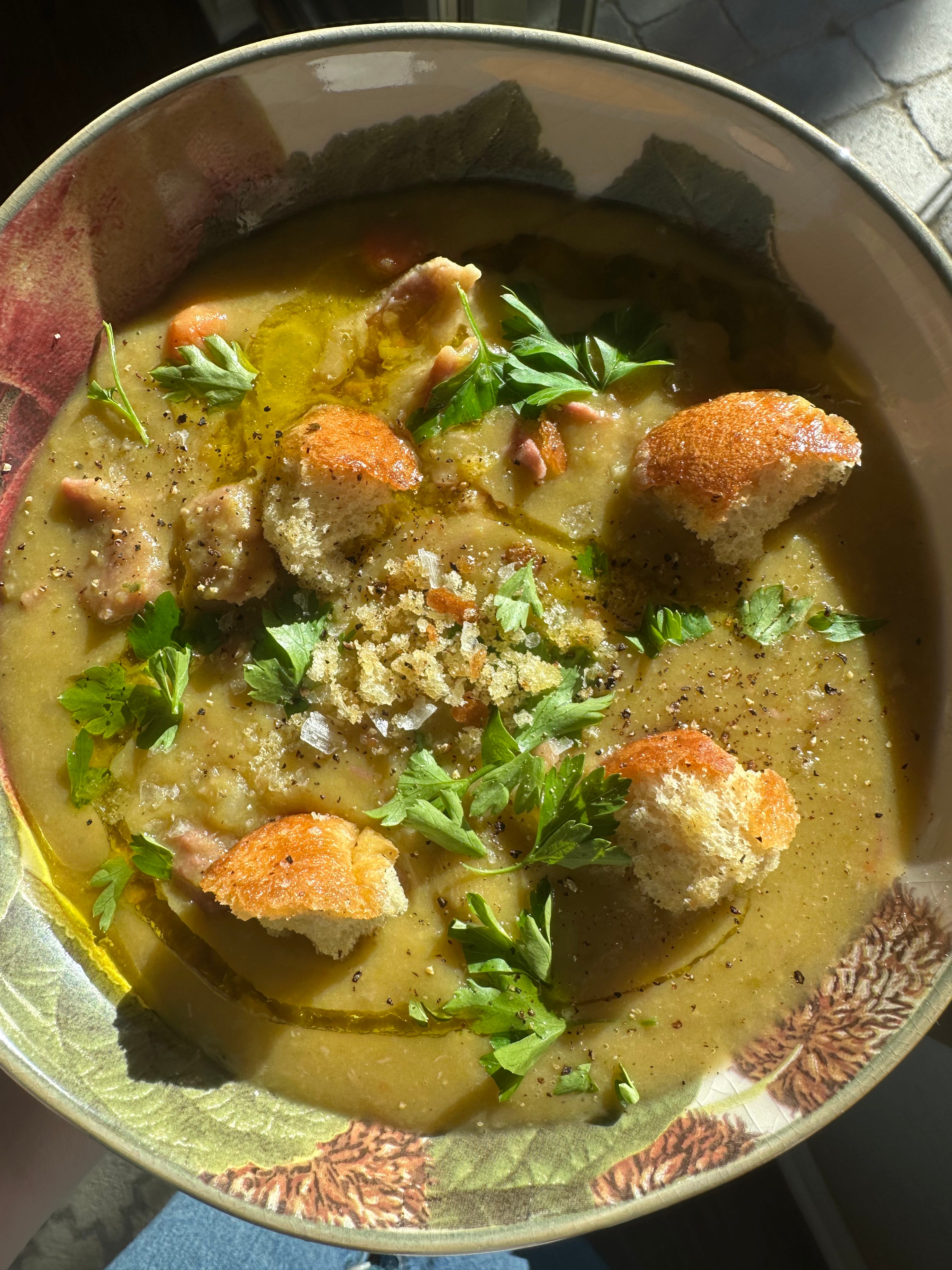
Happy New Year and welcome to 2026!
If you’re anything like me, the post-holiday season crash hits hard in January. After weeks of rich food, parties, and cookies, January is… January. It’s cold. People are inside. And the cure is soup.
More specifically, I like a soup that can quietly simmer on the stove for hours, with minimal prep, using things already in the house—like the leftover ham you’ve been endlessly nibbling on since Christmas.
Enter split pea soup. My mom and I made a big batch of split pea soup this week to inject some much-needed veggies into our bloodstream—but like, in a non-offensive way. It seems we weren’t alone: Simply tracking down a one-pound bag of split peas required trips to two grocery stores. Apparently everyone had the same idea but honestly, can you blame them?
We came up with our own hodgepodge recipe using elements from three sources: A cookbook aptly titled “Is it Soup Yet?” by Dot Vartan that my mom owns, Alison Roman’s version from her new cookbook, and a recipe on the back of the bag of split peas.
As my mom herself says, most of the things she cooks go this route. She starts with a recipe, makes it accurately once, and then riffs on her own version forever after.
Classic winter soup vibes
At its core, split pea soup is a traditional, classic soup. And as we’ve already discussed, I’m a sucker for classic food. The idea of making something one way for all of time because it’s a trusted and proven method by many humans is straight-up romantic to me.
In other words, you never have to twist my arm to eat a bowl of split pea soup. It also so happens to be a favorite of my mom’s—specifically in late December or early January, when she’s got loads of leftover ham hanging around that needs a new purpose and lease on life. You know it’s time to make this soup when the idea of yet another meal of ham and scalloped potatoes makes you queasy.
To get started, boil the ham bone in a large pot of water until all the golden nuggets of ham fall off. For extra credit, cool the ham-infused broth in the refrigerator, skim off the fat, and add some to the soup for more flavor.
Also, split pea soup doesn’t require any meat if you don’t want or have it. If you’re vegetarian or simply not a fan of pork, no big deal. You should still make this soup.
Soup is not for babies
I have a very important addendum to split pea soup that must be immediately addressed. The thing about split pea soup is that the texture is really a make-or-break situation.
Yes, you’re ideally going to need either a blender or an immersion blender (I’m an immersion blender stan for life—this is mine) to make this soup. Choosing to not use either will result in a soup that is too soupy and lacks the creaminess associated with split pea soup. You could also simply crush the ingredients of the soup with a wooden spoon to thicken it, and that would be fine. I can’t tell you what to do with your soup because we’re all adults with free will. But also—just use a gadget that blends.
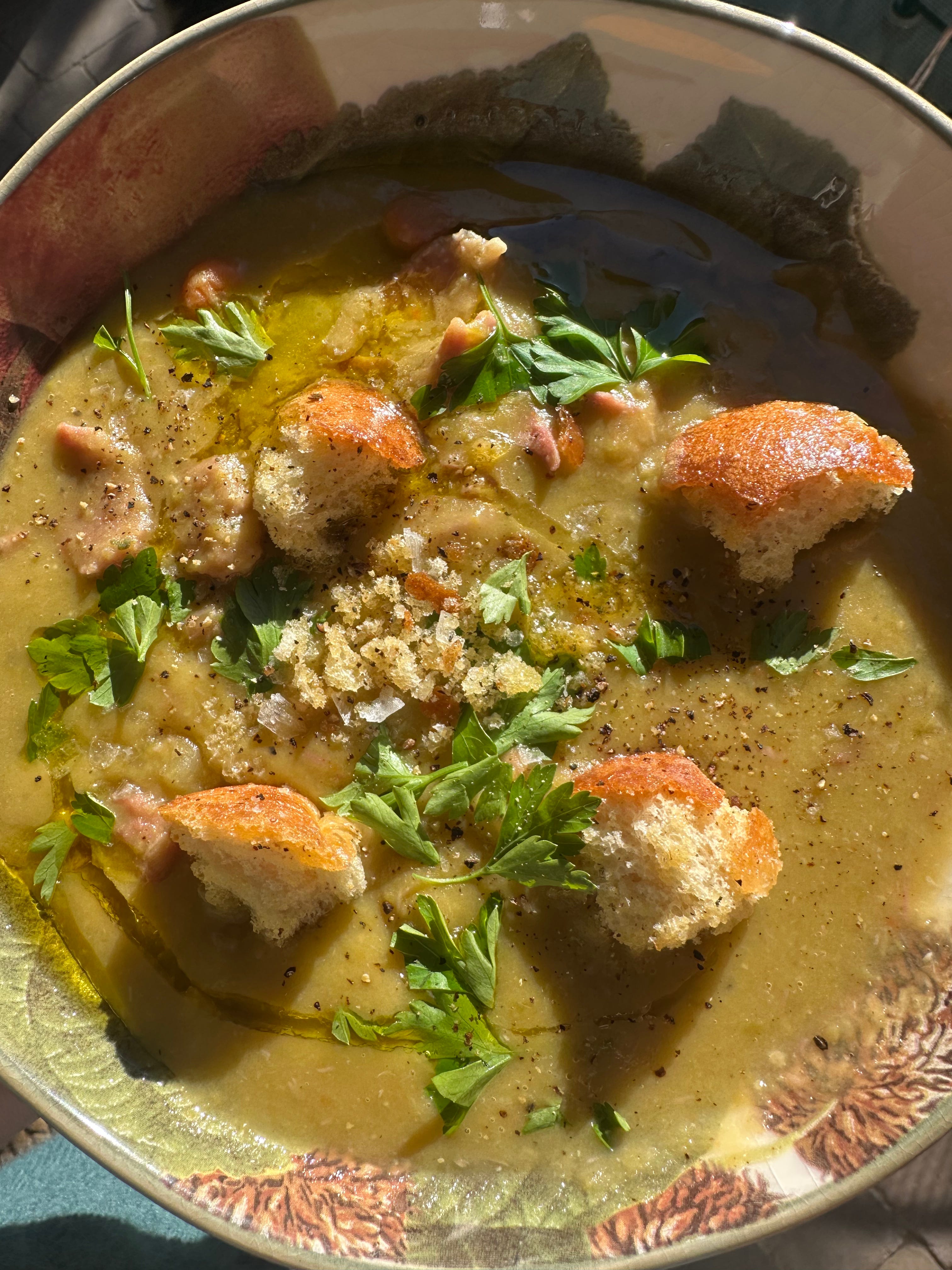
Now, here comes the caveat. The No. 1 rule in my book when it comes to split pea soup (and most soups for that matter): DO NOT FULLY PUREE YOUR SOUP. YOU ARE NOT A BABY, AND IT’S ONLY ACCEPTABLE FOR BABIES TO EAT FULLY PUREED FOOD.
Leaving texture from all the good stuff going on in here (onions, dried split peas, potatoes, carrots, celery, garlic, etc.) is not only necessary for making it more enjoyable to eat, it’s also necessary for presentation, aesthetics, and for enhancing the overall flavor profile. So please—use something to blitz the soup a bit but show some restraint when wielding the blender.
This is the result:
Other important things to note about this soup:
As mentioned, there isn’t a real recipe going on here. It is more a combination of a few recipes mixed with intuition. Is the soup too thick? Add more broth. Want more vegetables? Throw in carrots and celery. Learn to embrace the uncertainty of the journey.
We used a combination of covering the pot and uncovering the pot while it simmered to reach our ideal thickness. Again, there’s no right or wrong way—just go with the vibes.
We made croutons on top for some crunch. They were great.
I like to finish my split pea soup with a lot of fresh herbs (a surprise to literally no one) and a glug of olive oil on top.
Finally, you better be freezing the leftovers. I’ve never met a soup that can’t be frozen. And if you don’t, what on Earth are you eating after the world’s longest work day during the longest and most dismal days of the year? Be smart. Buy my favorite containers and freeze your soup.

As has already been discussed, I’m over all the rich food of the holidays and now want tangy, fresh, light food. So I immediately added Susanna Bowers’s fennel orange salad and green sesame slaw to my list of things to make.

The New York Times asked experts what food trends will be in for 2026. Spoiler: IT’S A GOOD YEAR TO BE A VINEGAR SNOB. The growing number of types and quality of vinegar is leading people to use it in new ways—like finishing something savory or sweet with a dash of vinegar.
Other trends to be excited for in 2026:
It’s time to show off your tinned fish packaging as decoration.
Restaurants will pare down menus and the size of services.
Celery desserts are here—as evidenced by dishes like the celery ice cream float at Smithereens.
Solo dining is cool.
And speaking of restaurants and dining out, Olivia Weiss’ rules for 2026 is worth reading and thinking about you want to prioritize and focus on this year. For me, that means exploring the places I already love more, trying some new places, and staying away from a lot of the restaurants that are only popular on TikTok/social media.


Happy 2026!!!
Having leftover split pea soup for dinner tonight! My go-to recipe is by Cal
Peternell in his great book Twelve Recipes. Cooks in an hour to a creamy consistency without a blender.
Thanks for the shout out 😊 soup looks delicious too!